—
Health System in Slovakia
Slovakia: Health System Review was published in the Health Systems in Transition series in 2011 by European Observatory on Health Systems and Policies and WHO Regional Office for Europe. Authors are Tomáš Szalay, Peter Pažitný, Angelika Szalayová, Simona Frisová, Karol Morvay, Marek Petrovič (all from Health Policy Institute) and Ewout van Ginneken (from the Observatory team).
The HiT profiles are country-based reports that provide a detailed description of a health system and of policy initiatives in progress or under development. HiTs examine different approaches to the organization, financing and delivery of health services, and the role of the main actors in health systems; describe the institutional framework, process, content and implementation of health and health care policies; and highlight challenges and areas that require more in-depth analysis.
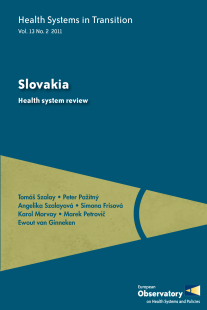 |
Slovakia: Health System Review
Authors: T. Szalay, P. Pažitný, A. Szalayová, S. Frisová, K. Morvay, M. Petrovič, E. van Ginneken Published by Observatory, April 2011, 203 pages ISSN 1817–6127 Vol. 13 No. 2 |
 download (pdf, 5 MB) |
The HiT profiles are country-based reports that provide a detailed description of a health system and of policy initiatives in progress or under development. HiTs examine different approaches to the organization, financing and delivery of health services, and the role of the main actors in health systems; describe the institutional framework, process, content and implementation of health and health care policies; and highlight challenges and areas that require more in-depth analysis.
Executive summary of Slovakia: Health System Review from the Health Systems in Transition series published in 2011 by European Observatory on Health Systems and Policies and WHO Regional Office for Europe.
- 5.1 Public health
- 5.2 Patient pathways
- 5.3 Ambulatory care
- 5.4 Inpatient care
- 5.5 Emergency care
- 5.6 Pharmaceutical care
- 5.7 Rehabilitation/intermediate care
- 5.8 Long-term care
- 5.9 Palliative care
- 5.10 Mental health care
- 5.11 Dental care
- 5.12 Complementary and alternative medicine
- 5.13 Health care for specific populations
The Slovak health system is a system in progress. Major health reform in the period 2002–2006 replaced all relevant health care related legislation and meant a new approach based on individual responsibility and managed competition. The health insurance funds became profit-making companies, hard budgetary constraints were introduced, and a new regulatory and institutional framework was created. The model sought to create an environment in which societal goals are met through incentives for market players. The future of this system largely depends on political will. Opposing political views may lead to different decisions regarding market mechanisms and state control. The government that entered into power in 2010 pledged to move forward with the market reform agenda.